
Howard Pyle, Public Domain, Through Wikipedia Commons
How To Immediately Make Weapons More Fun In D&D
One thing that has always bothered me about D&D 5e is how you almost always end up using the same weapon.
You roll up your character, pick your gear, and start the game. Oftentimes, until you get something objectively better - a +1 magic sword, perhaps - you're using that same short sword, spear, twin daggers, or whatever else for a long time. Even in classic editions of D&D, where weapon availability was sometimes restricted based on class, this is still mostly true. I'm a cleric that can't use blunt weapons - cool, I'm just going to be using this one cudgel for a long amount of time.
Mechanically, there's almost never any reason not to, and this is a really missed opportunity. D&D 5e, with its attempt at tactical combat, introduced the concept of different physical damage types. Slashing, piercing and bludgeoning. Swords do a different kind of damage to spears, which are different to clubs. It sounds like it would be perfect to solve this issue, right? Oh no, this knight is wearing armor and my sword can't poke through it! Looks like I'll break out my trusty flail!
This literally never happens. There's not one single instance I can remember in my time playing D&D 5e where anyone having one kind of physical damage over another benefited them. Yes, oftentimes elemental damage will have an effect - it would be dumb for a fire giant to be grievously injured by a fireball spell - but that's not really the same. In D&D 5e, when you have a monster that is incorporeal, or otherwise resistant to normal weapons (werewolves come to mind) it just says "this creature is resistant to bludgeoning, slashing and piercing damage"(Or something along those lines). I think that other games, like Pathfinder, utilize this system with a bit more finesse (pun intended). I wouldn't know, since I don't play Pathfinder, nor D&D 5e, but those classic editions of D&D still have this problem.
The reason that this is so important is that it's another vector to important decision-making. If your players make the choice of using the best-in-class option for the entire game, then there should be drawbacks. There should be some resistance from the game, because the challenge feeling real make the game so much more fun.
Let's imagine a hypothetical TTRPG. This game has only three weapons: Sword, Dagger and Big Sword. Sword does 1d6 damage every time you hit with it. Dagger does 1d4 damage every time you hit. And Big Sword does 1d8 damage. Which is the best choice? Everything being equal, Big Sword is obviously the best possible decision. Most of the time, D&D is this plus extra steps. You either pick Sword or Dagger or Big Sword and stick with it throughout the game.
Even my beloved Whitebox FMAG does this. If you're a cleric or wizard, you can only use blunt weapons or daggers and staves, respectively. If you're a thief or fighter, then you can use any weapon. This means that Rules-As-Written, any character playing those classes has to only ever make one choice: Sword, Dagger, or Big Sword. This is further exacerbated if there's never any chance where they might be without weapons (DMs, here's a friendly reminder: play dirty. If the goblins try and succeed to swipe the weapon out of the player's hands, then guess what the players are going to start trying to do. As long as both sides are allowed to do it, then it's fine).
Here, we come across an important issue. This current system works great for more abstract and less fiddly combat. You pick Big Sword, and you're off to the races. Adding more complexity risks moving the scale to the fiddly side of things. This isn't necessarily bad, but you'll eventually reach a point where you will end up with 30-minute long random encounters, which is never fun for anyone. We want to avoid this as much as possible. But as I've already laid out, the current system is lacking depth in a not particularly fun way. The question is: where's the balance? Luckily for us, this problem has a solution - and it's older than Dungeons and Dragons itself.
Way back in 1971, Gary Gygax, the creator of D&D, wrote Chainmail - a medieval war game for miniatures, which included, among other things, rules to allow for fantasy creatures fighting among normal soldiers. A little while later, Original Dungeons & Dragons (OD&D, though it obviously wasn't called that at the time) was created, and assumed that the player had a copy of Chainmail, where the game would derive its combat system from, with an optional rules for those who desired it. There is some controversy around the intention of this system. Essentially, it's mostly confirmed (at least to my knowledge) that the only reason this was included was to appeal to the wargaming scene, but that's not super relevant. I think that it's a good system to draw upon at the very least.
OD&D's optional sequence grew to be the d20 system we know and love to this day, but those original Chainmail rules have something interesting that shouldn't be overlooked. The rules describe soldier-to-soldier combat in addition to its normal large-scale combat. You would be able to simulate actual warfare among your troops, but also kind of zoom in to one on one battles, where your guys would fight each other directly. The way they do it is interesting, essentially comparing your soldier's weapon directly to the enemy's armor. These had different target numbers depending on the weapon or armor's class (Which is where Armor Class comes from). It would look something like this:
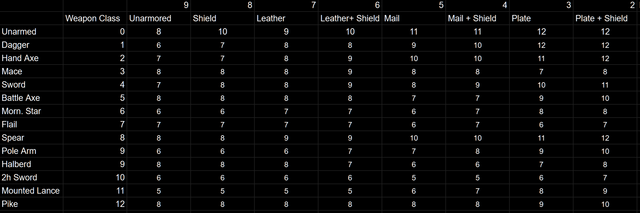
If I'm a soldier wielding a Morning Star, and I'm fighting another soldier wearing Leather. I would roll 2d6 trying to get equal or greater to 7, a roughly 58% chance. This fluctuates as the opponent changes AC. That same morning star against an enemy in Chain Mail requires a 6 or greater, which is around 70%. This is absolutely fascinating. It forces you to think about which weapons you're using against enemies.
We can apply this as-is to D&D, replacing the d20 system. What we end up with is the choice of both weapons and armor actually mattering in the grand scheme of things. If you're a fighter, and you only use a battleaxe, then you're going to have a great time against middle ACs, such as Chain Mail, or Chain Mail + Shield, having to roll above a 7. Oh, I'm going against a combatant with just a shield? Well, I have to roll above an 8 now… better whip out my sword!
That right there is the mindset we want to foster. It creates more mindfulness on the items that the players have. It's not just "I have Sword" or "I have Generic Adventuring Item." It creates real, tangible stakes when a play forgets to bring a mace, and they face a plate mailed enemy, or if they've gotten rid of it for a +1 sword. That latter case would really make for such a bittersweet moment at the table.
If you inspected the above chart, you might have noticed that one weapon stands out among the rest: the flail. It rolls a 7 or 6 for every value. Yeah, it is the best-in-class weapon, and for good reason. Giant swords, pikes or spears are unwieldy, and smaller weapons are often ineffective against heavily armored opponents. This system is fantastic, because it makes sense, based on not just the fiction, but also real-life physics. This also makes weapons restrictions matter so much more. Like I said before, OD&D only let Clerics use blunt weapons, of which the flail is (mostly) in that category. After fighters, Clerics are the second front-line attackers, so they give up the flexibility of Fighters having unrestricted weapon use for being able to use one of the most powerful options available to them. This system also combines rather well with house rules for extant weapon options.
In my campaigns, when wielding a 2-hander, you get a +1 to damage rolls, and when dual wielding weapons, you get a +1 to attack rolls. Flails can't be dual wielded for obvious reasons, so they're exempt from these options (Using this system, I'd specify that you can only dual wield weapons with a weapon class 4 or less). All-in-all, this system is great! It allows the players more flexibility, while also testing their preparation skills and common sense. But… it just doesn't cut it, not for me. It's difficult enough to get the players to remember their character sheets, let alone a completely new attacking system. The d20 system is so enfranchised in the minds of players that it would be hard to completely replace this. If only there was some version of this that still used the d20, but would be able to implement a system like this smoothly…
Stay tuned.
This blog is, and always will be, 100% human-generated.